• Venturi Tech Talk registration banner

    VENTURI ENTERPRISE AI

    Enterprise AI. 
    Engineered for What
    Comes Next.

    Build, place, and scale AI workloads across core, edge, cloud, and the models best suited to each task.

TURNKEY INFRASTRUCTURE

We Do Not Simply Architect GPUs. We Architect the Entire AI Factory.

A production AI environment requires more than accelerators. Compute, networking, reusable context, orchestration, governance, and model routing must operate as one coordinated system.

Designed, integrated, and operational from network fabric to model routing. 

Right sized for your use-case.

01
DefineWhat Is an AI Factory?

An AI factory is the complete system that turns enterprise data, models, and workloads into repeatable AI outcomes.

The factory is not one product. It is the integrated operating environment around AI.


02
Right-SizeFactory Describes the Function, Not the Size.

An AI factory can be a compact single-system deployment, a partial rack, or a larger clustered environment.

Start with the capacity you need while preserving the architecture required to grow.
03
OperationalizeA GPU Server Is a Component. The Factory Is the System.

Accelerators provide compute. The surrounding factory makes that compute secure, observable, schedulable, context-aware, and available to the business.

The hardware runs the model. The factory makes AI operational.
04
DeliverBuild for the Workload You Have.

Venturi designs the factory around your models, users, data, response-time requirements, security posture, and expected growth.

Not the largest AI factory. The right AI factory.

​​ARCHITECTURE

AI Infrastructure
Built on Familiar IT Principles. Only the Scale Has Changed.

Running an AI Factory is not a departure from enterprise IT. The same foundational concepts still apply: compute, storage, networking, security, resilience, data management, and operational efficiency. What has changed is the speed, scale, density, and power requirements demanded by modern AI workloads. Venturi helps organizations translate familiar IT disciplines into high-performance AI infrastructure, removing the guesswork from architecture, sizing, and deployment while accelerating the path to business outcomes.

Familiar Foundations. Extraordinary Possibilities.

Step 1 of 4: Connect and control
Venturi AI FactoryIntegrated physical and operational platform
Physical SystemNetwork, management, compute, memory, and shared context
01
400 Gb Top-of-Rack Network FabricMoves data, context, and model traffic without creating a bottleneck.
Connect
02
Management InfrastructureProvides resilient control, administration, and integration.
Control
03
Venturi AI Compute Node + Server HBMHigh-density acceleration and memory for enterprise AI workloads.
Compute
04
Shared KV CacheMakes reusable context available across AI compute nodes.
Remember
Operational PlatformGovernance, orchestration, and intelligent model execution
05
Observability, Security + GovernanceMonitors performance, access, policy, and system health.
Govern
06
Kubernetes + Workload OrchestrationSchedules, scales, and governs AI services.
Orchestrate
07
Model RoutingSelects the appropriate private, cloud, specialized, or frontier model.
Operate
DesignedIntegratedOperational

INTELLIGENT PLACEMENT

Right Workload. Right Model. 
Right Location.

Venturi orchestrates AI from the enterprise core, evaluating each workload and routing execution to private models, cloud services, or frontier models according to cost, privacy, latency, and required capability.

COST • LATENCY • PRIVACY • DATA GRAVITY • POWER • CONTEXT • MODEL CAPABILITY

Evaluating cost, privacy, latency and capability
Enterprise WorkloadData, prompt, agent or application request
Enterprise CorePrivate AI Factory
Venturi AI OrchestrationEvaluates policy, economics, latency, privacy and model capability
CostPrivacyLatencyCapability
Local
Private ModelsExecute within the AI factory
Cloud
Cloud AIElastic services and specialized models
Frontier
Frontier ModelsAdvanced capability when required
Enterprise WorkloadData, prompt, agent or application request
Enterprise CorePrivate AI Factory
Venturi AI OrchestrationEvaluates policy, economics, latency, privacy and model capability
CostPrivacyLatencyCapability
Local
Private ModelsExecute within the AI factory
Cloud
Cloud AIElastic services and specialized models
Frontier
Frontier ModelsAdvanced capability when required

INFERENCE CONTEXT ARCHITECTURE

Give the 
AI Factory a Shared Memory.

Inference is where enterprise AI creates value. Venturi expands the context available to inference workloads across GPU memory, server memory, and a shared KV cache accessible throughout the AI factory.

More context. Less recomputation. 
Better GPU economics.

Expanding inference context
01
GPU MemoryImmediate active inference context
Fastest
Smallest Capacity
Highest cost per unitLowest latency
02
Server HBMExpanded context capacity within the server
High Speed
Larger Context Envelope
More context per serverClose to compute
03
Shared KV CacheContext accessible across GPU nodes
Cluster Scale
Shared Inference Context
GPU 1GPU 2GPU 3GPU 4
Available across nodesReduces repeated context processing
More ContextAvailable to inference workloads
Less RecomputationAcross repeated requests and agents
More Productive GPUsFor new inference work
01
GPU MemoryImmediate active inference context
Fastest
Smallest Capacity
Highest cost per unitLowest latency
02
Server HBMExpanded context capacity within the server
High Speed
Larger Context Envelope
More context per serverClose to compute
03
Shared KV CacheContext accessible across GPU nodes
Cluster Scale
Shared Inference Context
GPU 1GPU 2GPU 3GPU 4
Available across nodesReduces repeated context processing
More ContextAvailable to inference workloads
Less RecomputationAcross repeated requests and agents
More Productive GPUsFor new inference work

PRODUCTIVE GPU CAPACITY

Stop Asking 
GPUs to Relearn What the AI Factory Already Knows.

Repeated long-context inference can force GPUs to rebuild context they have already processed. Shared KV cache restores reusable context faster and returns GPU capacity to new inference work.

Restore what is known.
Compute what is new.

Step 1 of 4: Recognize reusable context
Reusable Inference ContextInformation repeatedly referenced by long-context workloads
System InstructionsConversation HistoryRetrieved DocumentsTool DefinitionsAgent State
Cache MissRebuild reusable KV state from the prompt
GPU PrefillRecomputing known context
Full KV Recomputation0.0 s
New inference requestAgent tool stepNew inference request
The request waits.The GPU repeats work that has already been completed.
Cache HitRestore previously computed KV state
Shared KV CacheReusable long-context inference state
GPU Ready for New WorkKnown context restored instead of rebuilt
Storage-Backed KV Restore273 ms
New RequestAgent StepNew Output
The GPU returns to useful work sooner.Restore what is known. Compute what is new.
10.3x
Faster TTFT273 ms restoration versus 2.8-second recomputation
~90%
Lower Time to First TokenIn the tested 128K-context inference workload
~2.5 s
Repeated Prefill AvoidedGPU capacity can return to useful inference sooner
Long-context inference carries forward what the model already knows.Instructions, history, documents, tools and agent state can recur across requests.
1
ContextRecognize what repeats
2
RecomputeExpose the penalty
3
RestoreReuse known context
4
ImpactRecover useful capacity
Tested result for a defined model, 128K-token context, system and cache configuration. Performance varies by model, reusable-context match, cache location, interconnect, concurrency and architecture.
KV cache impact

Reusable Inference Context

Long-context workloads repeatedly reference known instructions, history, documents, tools and agent state.

System InstructionsConversation HistoryRetrieved DocumentsTool DefinitionsAgent State

Cache Miss

The GPU rebuilds reusable KV state from the prompt, delaying new work.

2.8 s
Full KV RecomputationThe GPU repeats work already completed.

Cache Hit

Previously computed KV state is restored so the GPU can return to useful inference sooner.

273 ms
Storage-Backed KV RestoreRestore what is known. Compute what is new.
10.3x
Faster TTFT273 ms restoration versus 2.8-second recomputation
~90%
Lower Time to First TokenIn the tested 128K-context workload
~2.5 s
Repeated Prefill AvoidedGPU capacity can return to useful work sooner
Restore what is known. Compute what is new.Reusable context can reduce repeated prefill and return GPU capacity to useful inference sooner.
Tested result for a defined model, 128K-token context, system and cache configuration. Performance varies by model, reusable-context match, cache location, interconnect, concurrency and architecture.

AI ECONOMICS

Reserve Frontier Intelligence for Frontier Problems. 

Not every enterprise inference workload requires frontier-model economics. Purpose-matched private models can deliver the required outcome while reserving frontier services for tasks that justify their capability and cost.

Use the right intelligence at the right price.

Step 1 of 4: Define the workload
Developer-Sidecar WorkloadCoding assistance with recurring developer context
Kimi K2.7 Code1 Million Tokens30%–40% Expected Cache HitFive-Year System Model
Comparable Frontier ConsumptionAPI-based execution reference
Frontier ModelConsumption-priced inference
Relative modeled cost100%
Reference Baseline100%Normalized comparison cost
Venturi Private AIPurpose-matched local execution
Private Coding ModelOwned enterprise inference
Relative modeled cost~5%
Modeled Private-AI Cost< $0.40Per 1 million tokens
~95%
Lower Modeled CostFor the defined developer-sidecar comparison
< $0.40
Per 1 Million TokensUsing the modeled Venturi system lifecycle
Right Fit
Model EconomicsReserve frontier capability for frontier problems
Start with the workload, not the model brand.Define the required outcome, context, privacy, performance, and operating economics.
1
WorkloadDefine the requirement
2
FrontierEstablish the baseline
3
Private AIMatch model to workload
4
ImpactCompare the economics
Modeled developer-sidecar comparison using Kimi K2.7 Code on a Venturi-designed system versus comparable frontier-model API consumption. Results vary by token mix, utilization, cache behavior, model, power, lifecycle, and operating assumptions.

PURPOSE-BUILT AI DENSITY

You Could Assemble Thousands of Small Systems. 
Or Engineer One Complete AI Factory.

Start with one general-purpose system

General-Purpose Small Systems

Approximately 5 tokens per second each

1Mac minis
One system for experimentation
OR

Venturi AI Factory

Purpose-built enterprise inference

400 Gb Fabric
Venturi AI Compute Node
Shared Context
VENTURISIZE: SMALL
Approximately 1/5 RackCompact, integrated AI factory
~4,000
Raw Throughput Comparison20,000 TPS divided by approximately 5 TPS
Up to 40,000
Agentic Context ComparisonEligible context processing at a 90% KV cache-hit rate
Experimentation can run on almost anything.Start with one system, then scroll slowly to examine what scale requires.
Modeled comparison using defined hardware, model, and workload assumptions. Visible Mac mini representations summarize the modeled system count. Cached-context capacity is not a claim of equivalent end-to-end application performance.

​​SIZED FOR USE-CASES, NOT GPUS

Stop Sizing GPUs. Start Sizing AI Outcomes.

Anyone can recommend a number of GPUs. Very few can tell you whether your AI application will perform with 500 users, a 128K context window, and your target response time. Our unique AI sizer models real customer workloads to predict performance and right-size infrastructure with confidence.

Built around users, models, context, and outcomes.
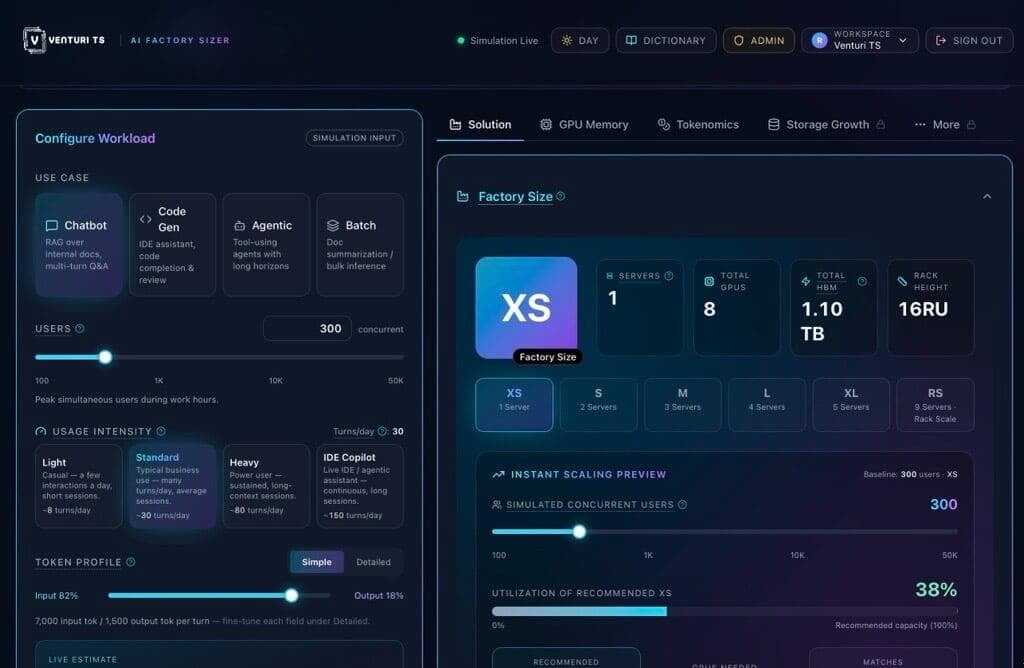
Venturi TS Sizer App Screenshot