Risk:
Sensitive, confidential, or proprietary information may enter environments outside enterprise governance.
Invisible Demand:
The organization cannot accurately understand, govern, budget for, or architect around AI demand it cannot see.
Lost Intelligence:
Useful business context, prompts, workflows, evaluations, refinements, corrections, efficiencies, and learned practices are being developed outside the organization's governed AI capability.
You cannot size, govern, or compound what you cannot see.
WHAT IS SHADOW AI?
The Work May Be Valuable. The Environment is Not Governed.
Shadow AI is AI used for work outside approved channels: public assistants, personal subscriptions, consumer apps, browser extensions, AI features inside SaaS tools, and agents someone wired up on their own. Each can carry contracts, code, client records and strategy to a provider whose terms you never accepted.
Employees may be discovering useful prompts, better workflows, faster research methods, new automations, coding efficiencies, or improved ways of working. But when those improvements happen inside personal or unmanaged AI environments, the enterprise may have little visibility into what is being learned, reused, or optimized.
Shadow AI can therefore expose sensitive information and allow useful organizational knowledge to develop outside the organization's intelligence system.
The employee captures the productivity. The enterprise should capture the capability.
THE PURPOSE BEHIND THE PROMPT
Not All Shadow AI is the Same.
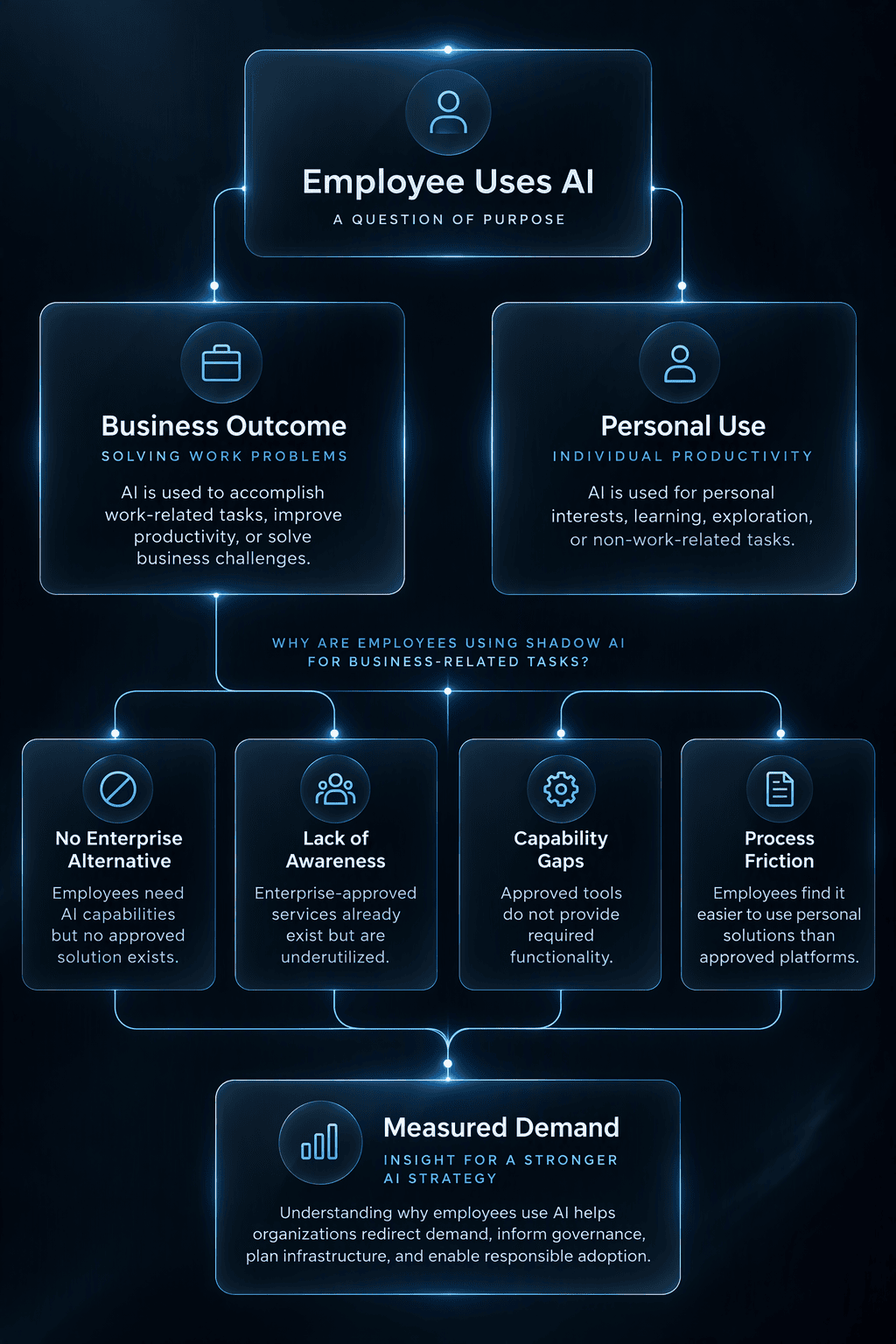
One of the most important distinctions is purpose.
Organizations frequently discover that AI activity falls into two broad categories:
Personal Consumption
- Resume writing
- Personal projects
- Education
- Creative activities
- General experimentation
- Career development
- Personal planning
Business Consumption
- Code generation
- Document summation
- Proposal creation
- Research assistance
- Knowledge retrieval
- Customer communications
- Workflow automation
This is where Shadow AI becomes strategically important. When employees repeatedly use unmanaged AI to perform business work, they are doing more than consuming tokens. They may be developing repeatable prompts, improved workflows, accumulated context, corrections, business rules, and operating practices that makes AI increasingly useful.
That learning belongs in the enterprise intelligence system, not fragmented across personal accounts and unmanaged applications.
THE SIGNAL BEHIND THE SHADOW
Shadow AI Is Evidence of Something Needing to be Fixed.
Understanding why Shadow AI exists does not make unmanaged AI acceptable. It tells the organization what must be fixed.
- Lack of Available Tools: You have a capability gap.
- Lack of Awareness: There is an approved tool/service that nobody knows about - you have an adoption problem.
- The Tool Can't Do the Job: You have an architecture or workload gap.
- Easier to Use Personal Tools: You have a friction problem.
- Specialized Workloads: Certain teams require models, agents, or workflows that differ from enterprise-standard offerings - You have demand to capture.
When Shadow AI occurs, it's a problem. That problem can be obvious: a breach of confidentiality, a leak of sensitive data, or a security risk. But even when it's an efficiency that improves business productivity, if it's occurring outside of your organization's governance and control, it's a loss of competitive advantage, business intelligence and compounding value.
Shadow AI is evidence of a problem. It is not the desired operating model.
THE HIDDEN COST OF SHADOW AI: LOST INTELLIGENCE
The Enterprise Can Lose More than Data.
Most Shadow AI discussions focus on what information employees might put into an AI system. That risk matters. But there is another question that should be considered: What is the employee teaching AI about your organization?
Over months of real work, people refine prompts, build custom assistants, train AI on the rules that get the best answers, learn which models handle which tasks better, and correct the output until it fits how your business works. The result is more valuable than any single answer. It is a better way of doing work.
In a personal account, that knowledge is invisible to your organization, can't be reused by anyone else, and walks out the door when your employee does. Shadow AI breaks compounding intelligence by building it up where the business can't see, govern or keep it.
If your employees are teaching AI how your business works, the business should keep that learning.
INVISIBLE DEMAND
You Can't Size the Infrastructure Until You Understand the Work.
If hundreds of people do business work on personal AI accounts, the usage you can see understates real demand, and every capacity plan, license count, and budget built on it is wrong. Token volume is useful. Knowing why people need those tokens is more useful. It shows which workloads matter, what context they need, which teams need which models, and where agents or a private AI platform would pay off.
Shadow AI affects capacity planning, model selection, adoption forecasts, token projections, cost modeling, infrastructure sizing, etc. Shadow AI also obscures what kind of intelligence your organization is actually trying to build.
The size of unaccounted Shadow AI usage is not a small error.
In our modeling, changing one unmeasured input [how heavily people use a chatbot assistant] can produce a 3x swing in the correct-sized platform.
You cannot size the infrastructure until you understand the work.
Make the invisible measurable.
THE WAY OUT
Convert Useful Shadow AI into Governed Enterprise Capability.
Organizations should not confuse widespread, unmanaged AI adoption with a sustainable AI strategy. The objective is not to preserve Shadow AI. The objective is to redirect useful Shadow AI demand into governed enterprise capability that you can control and keep accumulating.
STEP 1: MEASURE
Identify where AI is already being used and distinguish legitimate business demand from personal or inappropriate use.
STEP 2: GOVERN
Establish policies, data-handling requirements, acceptable-use standards, security controls, model access, and accountability.
STEP 3: REDIRECT
Move legitimate business workloads away from unmanaged personal tools and toward approved enterprise AI resources where security, context, workflows, and organizational learning can be controlled.
STEP 4: CAPTURE
Keep prompts, assistants, context and workflows on the governed platform, where the whole business can reuse and improve them.
Caution | Sequence Matters
Block Shadow AI before you measure it and the demand can move underground onto personal phones and home laptops. Redirect people to a platform sized on a guess and it may slow down during the first busy week, sending people right back to the tools you were trying to replace.
Discovery is the beginning. Redirection is the goal. Measurement is what makes it work.
Related Reading
Cost per million tokens, explained.
Consumption vs. Capability
From prompt to answer.
On-premises AI Micro Factory.