Renting vs. owning enterprise intelligence

AI Consumption vs. Capability

Renting AI capacity can make enormous sense. But compute and intelligence are not necessarily the same thing. As your organization surrounds AI models with proprietary context, workflows, prompts, evaluations, optimizations, feedback, integrations, and operational knowledge, something potentially more valuable than compute begins to emerge. 

Every business should ask: Is intelligence something you want to keep consuming, or is it a capability you ultimately want to own?

Intelligence is a competitive advantage that gets better because your organization uses it. The strategic question is not simply: What is the least expensive way to consume AI today? The better question is: Where does the learning accumulate, who controls it, and can you take it with you?

RENT COMMODITIES. 
OWN COMPOUNDING ADVANTAGES.

Business Intelligence Becomes More Valuable With Use

Think about everything your business contributes each time AI is put to work.

Your context. Your data. Your prompts. Your workflows. Your evaluations. Your corrections. Your feedback. Your business rules. Your operational experience.


At the beginning, the underlying compute and models may be largely interchangeable. But as your organization surrounds those commodities with everything that makes your business unique, something changes. You are no longer simply consuming intelligence. You are building capability.

Every successful workflow, refinement, evaluation, and lesson can contribute to a system increasingly shaped by how your organization operates.

Over time, the value may shift away from the commodity underneath it and toward the proprietary intelligence your organization has built around it.

The more your business contributes, the more important it becomes to ask where that value is accumulating and who controls it.
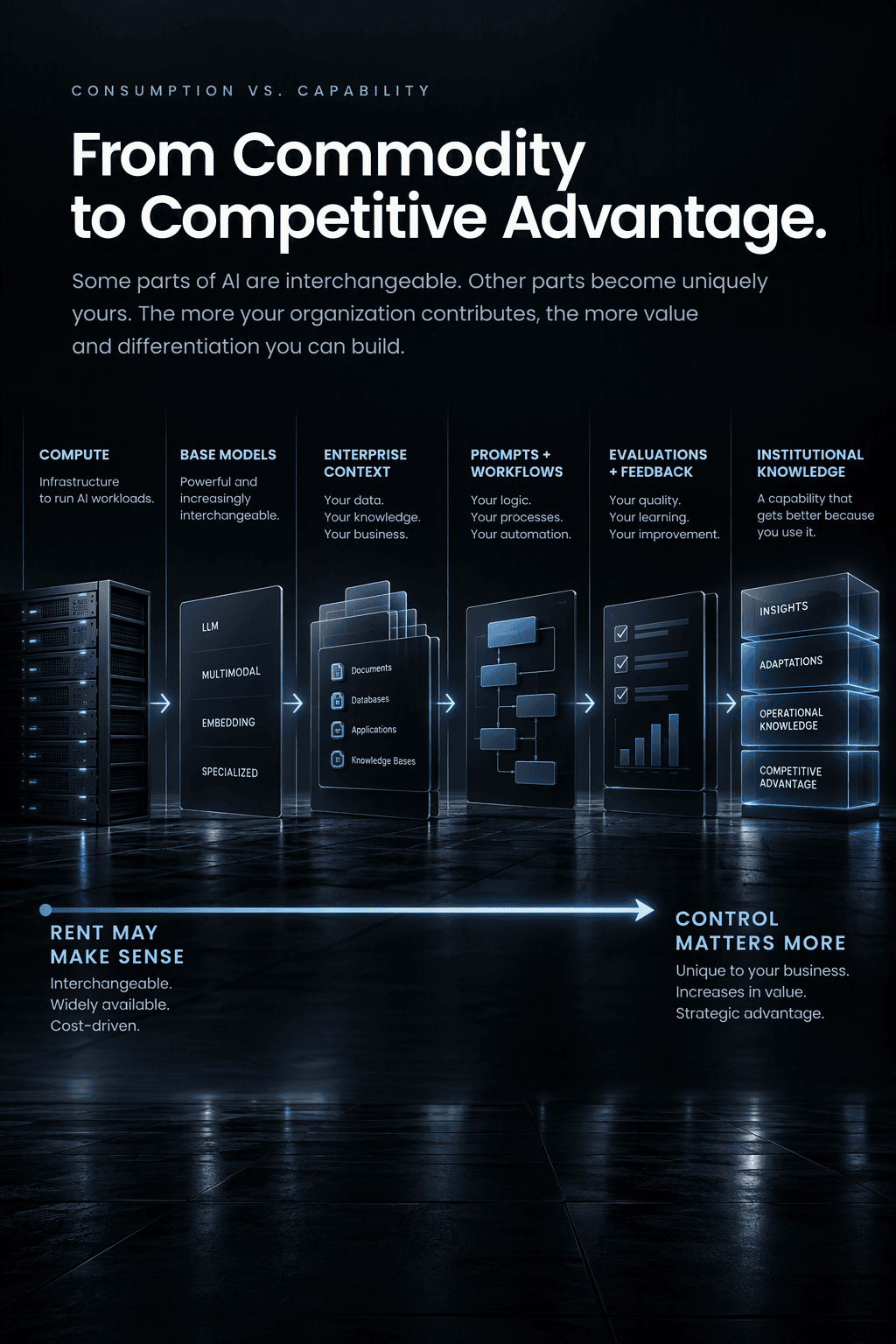
Commodity v Competitive Advantage

THE QUESTION ISN'T RENT OR BUY

What Exactly Are You Renting?

There is nothing inherently wrong with renting infrastructure. Businesses rent buildings. They lease vehicles. They consume electricity. They purchase cloud capacity. These arrangements work because using the asset generally does not make the underlying asset uniquely more valuable.

AI introduces a different variable. Your organization may continuously contribute: proprietary context, retrieval architecture, prompts, agent workflows, evaluations, guardrails, feedback, model adaptations, business rules, integrations, and operational experience. 
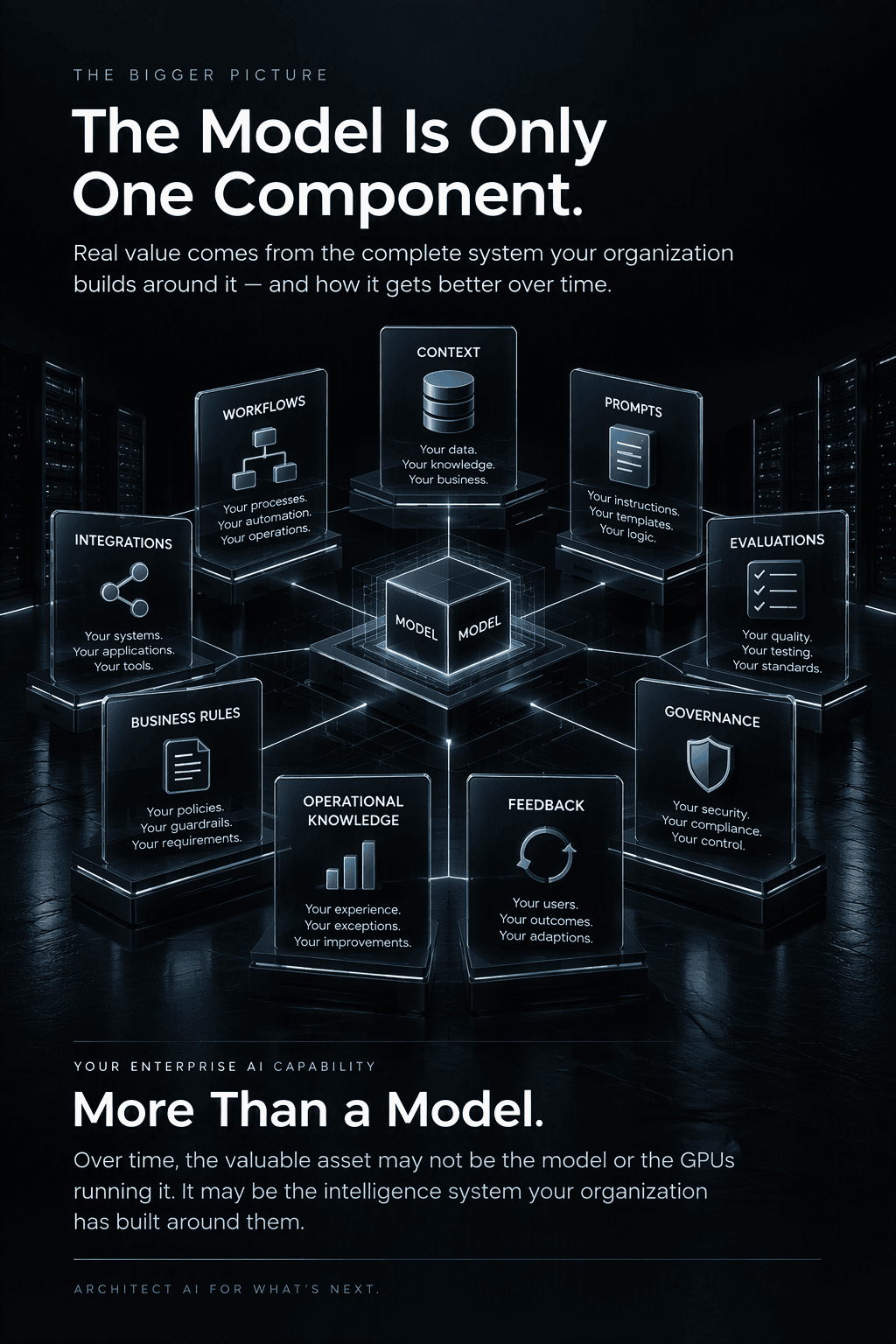
Over time, the valuable asset may no longer be simply the model or the GPUs running it. 

It may be the intelligence system your organization has built around them. 
Your Intelligence System

The technology will change. What your business builds around it can endure.

The Model is Only One Component

Models will change. GPU generations will change. Inference providers will change. Prices will change.

But the context, workflows, prompts, evaluations, optimizations, adaptations, and institutional knowledge your organization builds around AI may become more valuable every year. The model is only one component. The more interesting asset is the system your organization builds around it. 

The system may determine:
  • How effectively AI understands your business
  • How consistently it produces useful outcomes
  • How safely it operates
  • How quickly it improves
  • How difficult it is for competitors to reproduce
The strategic value may not live in any single model, application, or piece of infrastructure. It may live in how the complete system works together. 

Getting your data back doesn’t mean getting your advantage back

Imagine Outsourcing Your Institutional Memory

Imagine consultants attending every important meeting. They learn your customers. They learn your processes. They discover the exceptions. They learn what works, what fails, and why. After years of working with you, they become extraordinarily good at helping run the business.

Then, you decide to change consulting firms. You get your documents back. But do you get everything they learned?

This is the difference between data portability and capability portability. 

Recovering your files, logs, and exported data does not necessarily mean you can recover the complete system your organization spent years improving. 

Getting your data back is not necessarily the same as taking your intelligence with you. 
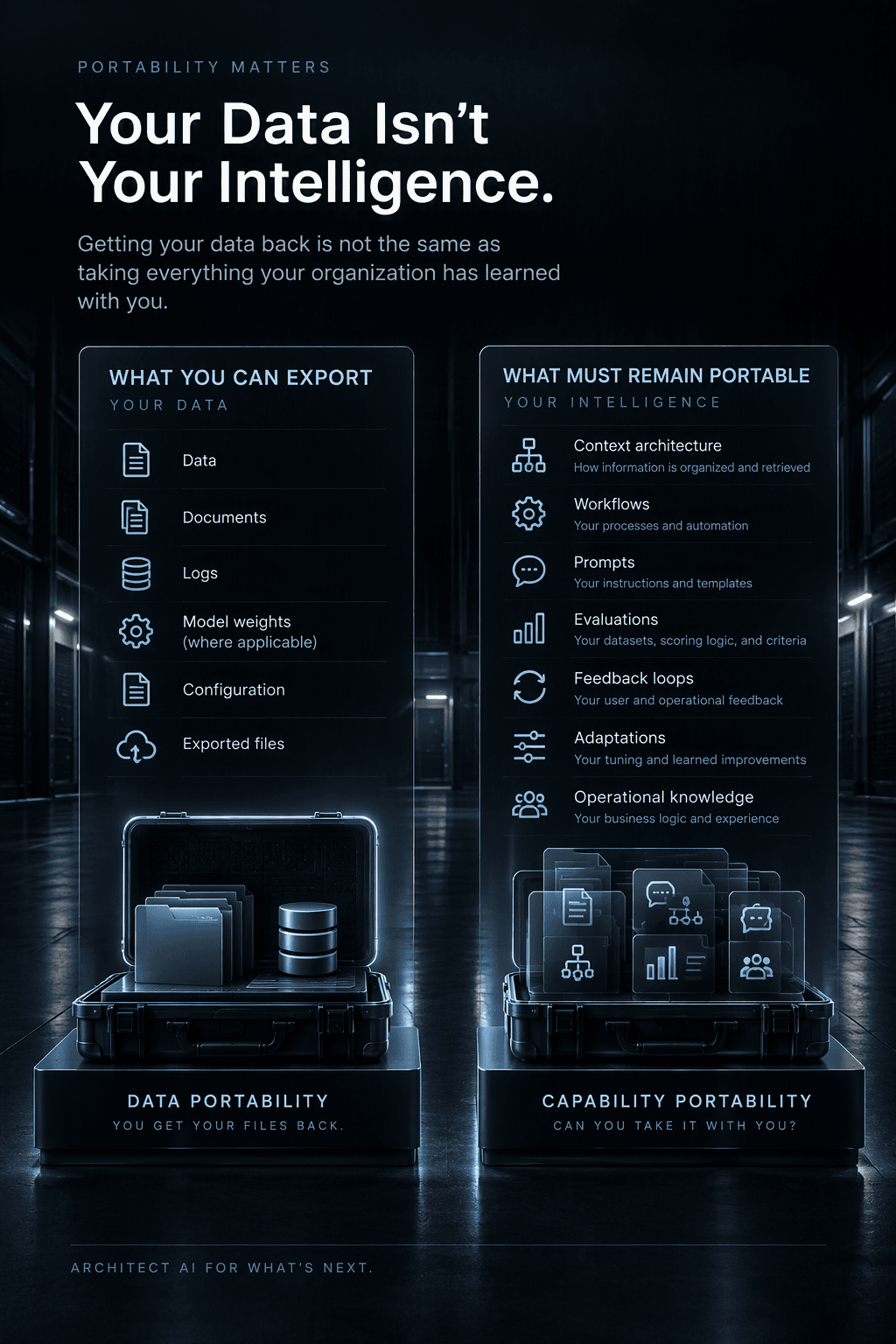
Capability Portability

The risk isn’t renting the building. 
It’s leaving your advantage inside.

Renting the Building Isn't the Problem

A restaurant can rationally rent its building. But imagine if the landlord also:
  • Owned the signature recipes
  • Remembered the customers
  • Trained the kitchen staff
  • Controlled the operating processes
  • Retained everything learned about running the restaurant better
Leaving would no longer mean simply changing locations. 

It would mean partially starting over. 

Compute is the building. 
Intelligence is increasingly the recipes, processes, experience, and institutional knowledge inside it. 
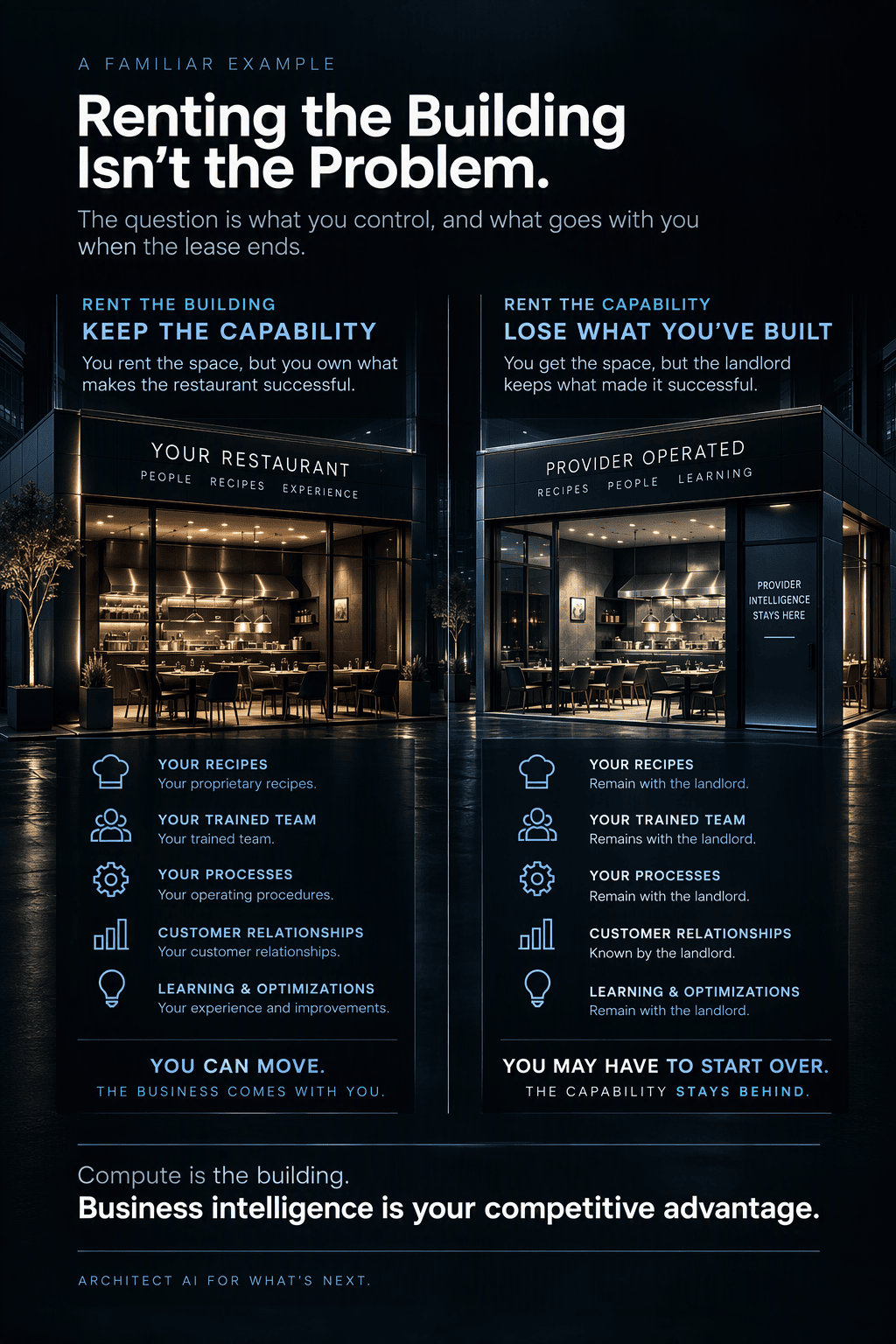
Intelligence Is Your Competitive Advantage

THE ECONOMICS OF ACCUMULATION

What if the Asset Appreciates Because of Your Investment?

Imagine leasing an asset that appreciates because of your investment, except you may not fully control or retain the appreciation. Most rented infrastructure does not become uniquely more valuable because one particular customer used it. 

Enterprise AI can be different.  

Your organization supplies:
  • Proprietary information
  • Business context
  • Evaluations
  • Workflows
  • Prompts
  • Feedback
  • Corrections
  • Adaptations
  • Operational experience
If those investments make the resulting intelligence more useful to your business over time, you are not merely consuming a service. You are investing in an appreciating asset. If you finance the learning, you should be able to take it with you. 

RENTING CAN BE THE RIGHT ANSWER

Not Every AI Workload Should Be Owned

Renting AI capacity can be the right fit when:
  • The use case is experimental:The business value has not yet been proven
  • Demand is unpredictable:Capacity requirements remain highly variable
  • The workload is temporary: There is no reason to acquire or reserve long-lived infrastructure
  • The intelligence is generic: Little proprietary differentiation accumulates around the workload
  • Speed matters most: Immediate access is more important than long-term optimization
  • Specialized capabilities are required: The organization needs access to models or services that are not appropriate for a privately operated environment
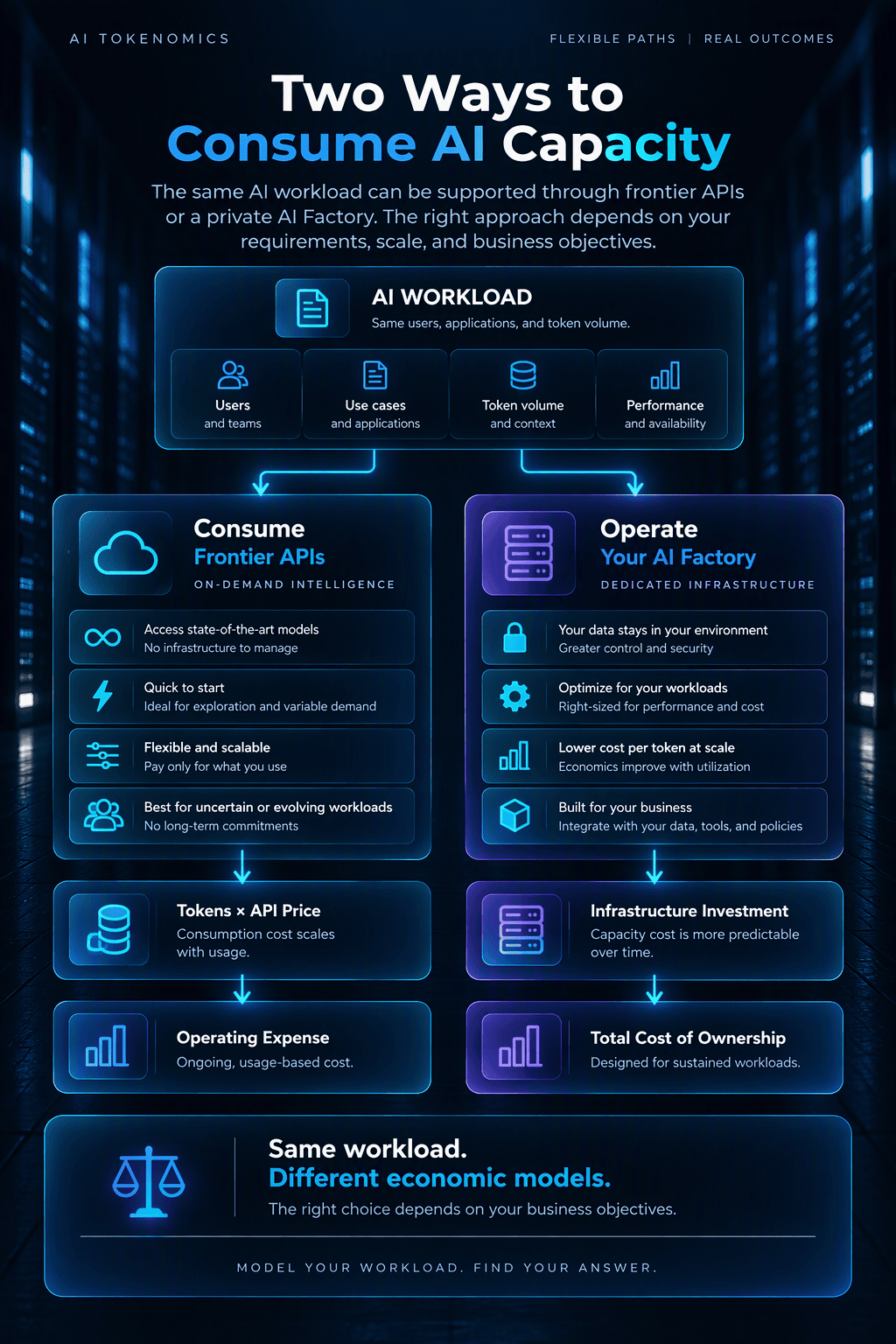
Consumption models can help organizations explore, validate, compare, and scale new ideas without premature infrastructure commitments. 

The risk isn't renting intelligence. The risk is accidentally renting what becomes your competitive advantage. Don't build institutional memory on a lease you can't carry out the door. 
Rent vs Own

The FIVE-YEAR QUESTION

The Longer AI Learns Your Business, the More Control Over that Learning Matters

After your company has spent millions of dollars teaching AI how your business operates, how your employees work, how your customers behave, what success looks like, which exceptions matter, how decisions are made, and how processes can improve - Where do you want that intelligence to live, and who do you want controlling it?
Models will change. Hardware generations will change. Inference providers will change. Prices will change. 

But the context, workflows, prompts, evaluations, adaptations, improvements, and institutional knowledge you have built around AI is where your strategic value and advantage has accumulated. 

What happens when you surround those models with everything that makes them uniquely yours?
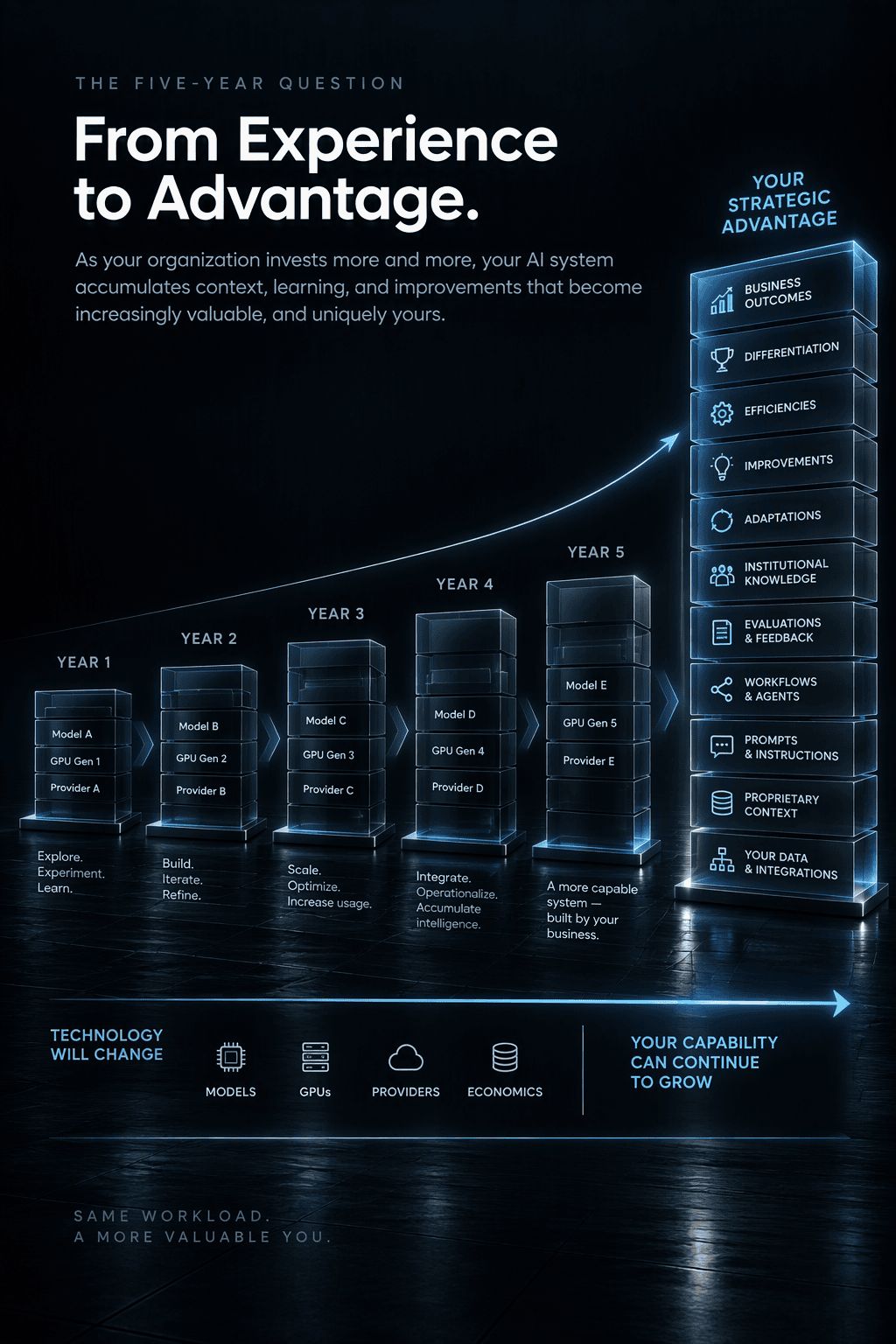
Strategic Advantage

Commodity to capability

There is a Point When Ownership is Worth More than Consumption Savings

If the intelligence surrounding your compute becomes increasingly unique to your organization, then the calculus changes. You have created a compounding asset. If that accumulated advantage is not portable, or under your control, then you are financing the appreciation of an asset you don't own. 

Architect your system so the underlying intelligence remains under your control and portable, rather than allowing convenience today to determine where tomorrow's institutional capability accumulates. It's rational to rent intelligence while it is a commodity. It's dangerous to accidentally rent what becomes your competitive advantage.