fROM COST PER TOKEN TO THE ECONOMICS OF ENTERPRISE AI

AI Tokenomics Explained

Every AI interaction consumes tokens. At small scale, those tokens may represent a relatively simple operating expense. At enterprise scale, billions of tokens per day can become a major infrastructure, architecture, and financial consideration. 

Understanding tokenomics helps organizations answer a more important question: At what point does consuming AI become less attractive than operating AI infrastructure designed around your workload?

Industry Perspective

Enterprise AI economics extend beyond the price of the token.

Recent industry discussion has raised a broader strategic question for enterprises: as organizations provide AI systems with proprietary context and institutional knowledge, how should they think about the value and control of what they contribute?

Read the Fortune article External perspective: Fortune, July 16, 2026. Link opens on Fortune.com.
AI Tokenomics

Gaining Insight into the Economics Behind Every AI Response

AI converts energy, infrastructure, and trained knowledge into business intelligence. That intelligence is measured in tokens, the fundamental unit consumed whenever a model processes information or generates a response. A token is approximately four characters of text, making tokens the common currency behind services such as ChatGPT, Claude, Gemini, and Grok.

Because individual tokens are extremely small and inexpensive, pricing is typically expressed as cost per million tokens ($/1M tokens). For example, a model may be advertised at $4 per million tokens processed. Most providers also differentiate between input tokens and output tokens, as the computational cost to ingest information is not always the same as the cost to generate a response.

💬

User Prompt

Question, instruction, workflow, or request.

→
📄

Input Tokens

Prompts, context, documents, and conversation history.

→
⚡

AI Model

Processes information and generates intelligence.

→
✨

Output Tokens

Generated text, analysis, recommendations, and code.

→
📊

AI Response

Business intelligence delivered to the user.

INPUT TOKENS

Prompt + Context

Documents, instructions, conversation history, and source data.

OUTPUT TOKENS

AI Response

Generated text, summaries, analysis, recommendations, and code.

TOKEN COST

Consumption Economics

(Input Tokens × Input Rate)
+
(Output Tokens × Output Rate)

COST AT SCALE

Why Token Economics Matter

A single AI interaction is inexpensive. Even several thousand tokens may represent only a few cents of consumption. However, costs increase rapidly as applications add larger prompts, retrieval-augmented generation (RAG), source documents, complex reasoning, or hundreds to thousands of concurrent users.

At scale, token consumption can grow from a negligible expense into a monthly operational cost measured in tens or hundreds of thousands of dollars. Understanding tokenomics allows organizations to evaluate when consumption-based AI services remain the right choice and when dedicated AI infrastructure may deliver a lower cost per token. The result is not simply cost optimization, but the opportunity to transform AI from a recurring expense into a strategic business asset.

SINGLE INTERACTION

One Prompt

A simple question and response may consume only a few thousand tokens.

Minimal token cost
PRODUCTION WORKFLOW

More Context

Documents, retrieval, conversation history, and complex instructions increase token volume.

Growing token cost
CONCURRENT ADOPTION

More Users

Hundreds or thousands of simultaneous users multiply consumption across every workflow.

Accelerating token cost
ENTERPRISE SCALE

Massive Consumption

AI embedded across the business can turn token consumption into a major operating expense.

Strategic cost impact
THE TOKENOMICS OF SCALE

Small interactions become significant economics when multiplied across the enterprise.

Token Volume×Usage Scale×Model Rate=Total Token Cost

THREE DEPLOYMENT SIZES. THREE VERY DIFFERENT ECONOMIC ANSWERS.

AI Tokenomics: When Ownership Wins

Private AI is not automatically cheaper. Scale, utilization, and strategic value determine when ownership wins. 


At small scale, frontier intelligence may cost less. Once an anchor workload justifies owned infrastructure, however, capacity outside that workload window becomes pre-funded innovation potential. The customer can apply it to new applications, fine-tuning, batch processing, evaluations, and growth without buying the same capacity again. 

MIcRO CLASS

Ownership Carries a Premium

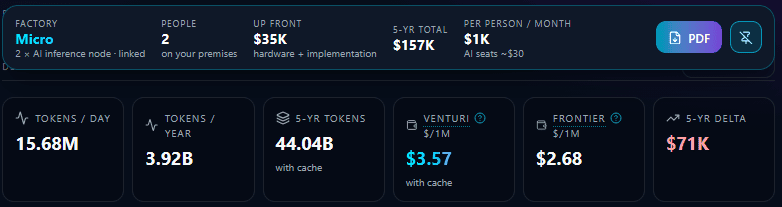
For this two-person deployment, renting equivalent frontier intelligence is less expensive than owning the infrastructure. The five-year premium for ownership is $71,000, or $0.45 per one million tokens. 

OWNED 5-Year Cost

$157K

FRONTIER Cost

$86K

OWNED $ / 1M TOKENS

$3.57

Ownership premium

$71K

At micro scale, private AI may not win on token cost alone. The case for ownership can come from something more valuable: control, continuity, confidentiality, sovereignty, and competitive advantage. For legal, accounting, healthcare, and other data-sensitive businesses, knowing where proprietary information and accumulated intelligence reside, how they are protected, and who controls them can be as important as the cost of inference. In regulated environments, those controls can also support the organization's broader privacy, security, and compliance requirements.


Imagine AI is the revenue engine for your small business. Frontier models may become cheaper, faster, and more capable. But the model is only one component. The more valuable asset is the intelligence system your business builds around it: proprietary context, prompts, workflows, evaluations, adaptations, optimizations, and institutional knowledge. Every improvement adds to a system increasingly unique to your organization. That accumulated intelligence is a compounding asset. With consumption-based AI, your data may be portable while that capability is not. Change providers, and you may take your files with you, but leave behind years of accumulated context, workflows, optimizations, efficiencies, and learning.

The strategic risk isn't losing your data. It's losing the competitive advantage you built from it.

Can your business afford not to control that intelligence?

Build it. Run it. Own it. Control it. With Venturi.

Venturi AI Micro Size

DEDICATED 4 CLASS

Ownership Starts Winning

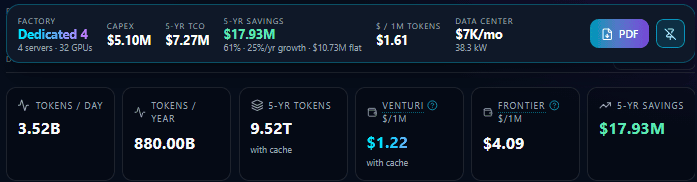
At sustained, mid-sized utilization, the economics begin shifting in the owner's favor. In this modeled scenario, owned capacity with cache reuse reduces the cost from $4.09 per million tokens through frontier consumption to $1.22 per million tokens, while producing $17.93M in modeled savings over five years.

OWNED 5-Year Cost

$7.27M

FRONTIER $ / 1M

$4.09

OWNED $ / 1M TOKENS

$1.22

MODELED SAVINGS

$17.93M

At this scale, ownership becomes easier to justify economically while also creating a strategic asset the business controls.

Dedicated GPU rental may still make sense when flexibility, deployment speed, or avoiding capital ownership matters more than achieving the lowest long-term unit cost.

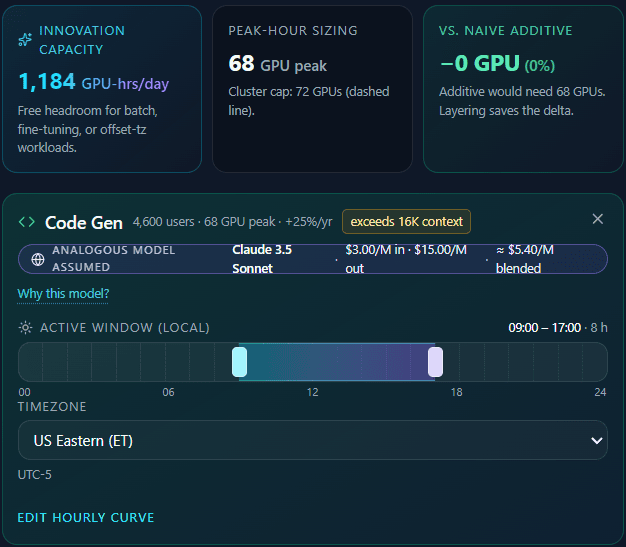
In this owned scenario, however, the primary workload already creates a compelling economic case. Capacity available outside the primary workload window becomes additional economic and innovation upside, supporting model fine-tuning, overnight batch processing, new AI services, experimentation, and future growth.

KV Cache Changes the Unit Economics

Reusable context is more than a performance optimization. Avoiding repeated context processing reduces the effective compute required to deliver the same application experience, improving efficiency and lowering the modeled cost per useful token.

Venturi AI Dedicated 4 Size
Venturi AI Dedicated 4 Workload

Rack scale CLASS

Frontier Tokenomics Break Down

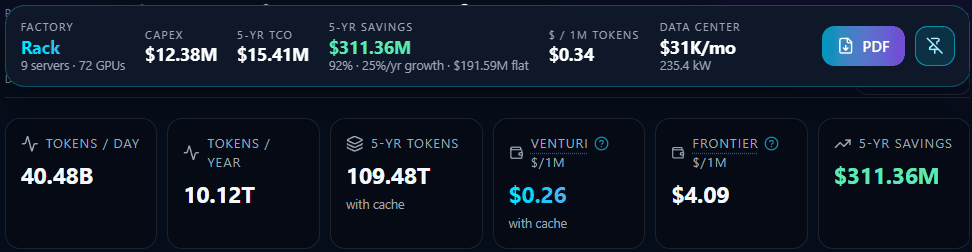
At rack scale, the economics can change dramatically. When sustained enterprise AI demand reaches this level, owned infrastructure can deliver the same modeled volume of intelligence at a fraction of the per-token cost of frontier consumption.

In the below modeled scenario, the primary workloads create a compelling economic case for the factory before accounting for the additional value of the capacity that remains available for other AI workloads.

OWNED 5-Year Cost

$15.41M

FRONTIER $ / 1M

$4.09

OWNED $ / 1M TOKENS

$0.26

MODELED SAVINGS

$311.36M

At this scale, ownership changes the conversation. The primary workloads are no longer simply consuming enough AI to justify dedicated infrastructure.They are establishing an AI production platform the business can continue building upon.


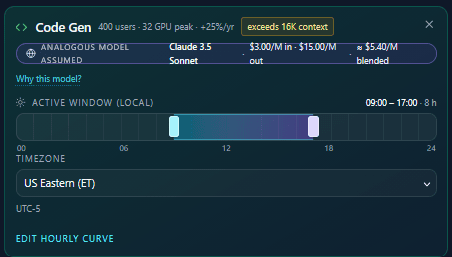
This scenario combines two code-generation populations across complementary active windows, creating sustained demand while preserving capacity for additional AI work. That remaining capacity is not simply an empty portion of the factory. It is deployable AI capacity the business already owns and can direct toward additional applications, new models, fine-tuning, evaluations, overnight batch processing, experimentation, agentic workloads, and future growth.


Instead of purchasing each new increment of intelligence by the token, the organization can increasingly ask a different question:

What else can we produce with the AI capacity we already own?


The Economics Extend Beyond the Anchor Workload

The Rack Scale scenario models40.48 billion tokens per day at $0.26 per million tokens with cache, while maintaining capacity for additional AI work.


Once the anchor workloads justify the factory, every additional productive workload placed into available capacity has the potential to increase the value generated by infrastructure already acquired.


The objective is not 100% GPU utilization for its own sake.

The objective is economically justified infrastructure with room to absorb the next valuable workload.

Venturi AI Rack Scale Size
Venturi AI Rack Scale Workload

STOP GUESSING. MODEL THE CROSSOVER.

Measure Useful AI Work

Cost per token is necessary, but it's not entirely sufficient. An owned AI Factory converts capital, energy, and infrastructure into productive AI work while creating room for the next workload. The goal is to justify the factory with valuable anchor workloads, then use the remaining capacity to accelerate what comes next. 

EFFICIENCY

Useful tokens / 
watt

CAPACITY

Useful tokens / 
GPU-hour

QUALITY

Output / 
$ of capacity

INNOVATION CAPACITY

Capacity beyond anchor workload

The cheapest token is not necessarily the best outcome. The stronger economic model delivers the required intelligence and control, justifies the factory with valuable workloads, and preserves innovation capacity the customer does not need to buy again. 

The Venturi AI Factory Sizer compares workload demand, workload windows, prompt reuse, infrastructure capacity, innovation capacity, and five-year economics to show where renting intelligence, renting GPUs, or owning an AI Factory makes sense. 

Stop guessing. Model the crossover.